Updated:
Red Ginseng Nanovesicles Show Potential to Protect Bone from Osteoporosis
SUMMARY
Osteoporosis is a bone disease in which the body loses more bone tissue than it forms, causing bones to become weaker and more likely to fracture. Researchers investigated red ginseng-derived nanovesicles (RGNVs) as potential therapeutic agents. Red ginseng is widely used in Asia for its health benefits and is rich in bioactive compounds called ginsenosides. In mice, orally administered RGNVs reached bone tissue and helped preserve bone structure over a four-week treatment period. These findings highlight the potential of RGNVs to support bone health and open new perspectives for osteoporosis research.
Key Insights
| Criterion | Description |
|---|---|
| Bone formation | RGNVs increased bone-cell activity, mineral deposition and the expression of proteins involved in building bone tissue. |
| Bone accumulation | Fluorescence in bone tissue peaked 48 hours after oral administration. |
| Bone breakdown | Treatment reduced the formation and resorbing activity of osteoclasts, the cells responsible for breaking down bone. |
| Dual action | More bone building (osteoblasts) and less bone breakdown (osteoclasts). |
| Bone preservation | In osteoporotic mice, bone volume and trabecular number increased, while the spaces between trabeculae, the small structures forming the inner bone network, decreased compared with untreated mice. |
Red Ginseng Nanovesicles Can Reach Bone Tissue After Oral Administration

Korean ginseng, a traditional medicinal plant widely used in East Asia for its many health benefits.
Red ginseng contains compounds called ginsenosides that have been reported to protect bone in earlier studies. However, delivering these compounds to bone tissue can be challenging because they may be degraded during digestion or cleared from the body before reaching their target.
To investigate whether nanovesicles derived from red ginseng (RGNV) could help overcome this challenge, the researchers labeled the vesicles with a near-infrared fluorescent dye and administered them orally to mice.
The Newton 7.0 was used to image the collected tissues, and the results showed that the signal was initially strong in the digestive tract. By 24 hours, it was also detected in several organs, including bone. These findings indicate that orally administered RGNVs can reach bone tissue, an important step towards investigating their potential therapeutic use.
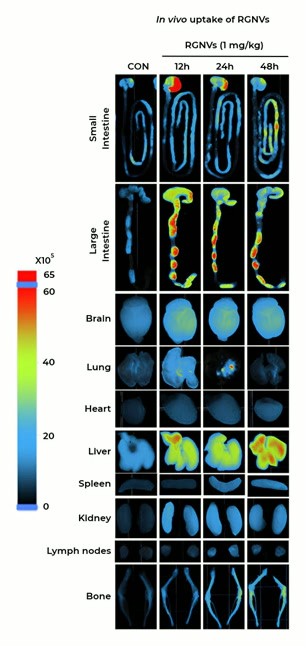
Figure 1. Biodistribution of RGNVs in the small intestine, colon, brain, lung, heart, liver, spleen, kidney, lymph nodes and bone of mice at 12, 24 and 48 hours after oral administration. The fluorescence signal indicates RGNV distribution.
RGNVs Promote Bone Formation and Limit Bone Breakdown
Bone is continuously renewed through two complementary processes: osteoblasts build new bone, while osteoclasts break it down. The researchers investigated whether RGNVs could influence both types of cells.
In cell experiments, RGNVs stimulated osteoblast differentiation and mineralization, the process through which minerals strengthen the developing bone matrix. They also increased levels of Runx2, a protein that helps activate the genes needed for bone-forming cells to mature, alongside other proteins involved in building the bone matrix. RGNVs also increased activity in the BMP-2/Smad signaling pathway, a system through which cells receive and transmit signals that promote bone formation.
At the same time, RGNVs reduced osteoclast formation and activity. The treatment lowered levels of proteins involved in osteoclast development and bone resorption. It also reduced the activity of the signals that trigger osteoclast formation.
Western Blot Analysis
The team visualized the proteins associated with both bone formation and bone breakdown with the Fusion Solo X through Western blot analysis. By comparing protein signals in treated and untreated cells, the researchers found molecular evidence supporting the two complementary effects of RGNVs: promoting bone formation while limiting bone resorption.

Figure 2. Expression of bone formation-related proteins in RGNV-treated cells. Runx2, ALP, OPN and ProCOL1 are proteins involved in osteoblast differentiation and bone tissue formation. Their higher expression in RGNV-treated cells compared with untreated controls (CON) supports the role of RGNVs in promoting bone formation.
Four Weeks of RGNV Treatment Helped Preserve Bone Structure in Mice
The researchers next tested RGNVs in a mouse model of osteoporosis induced by ovariectomy, a procedure that reduces estrogen levels and reproduces some of the bone loss associated with menopause.
The mice received oral RGNV treatment over four weeks. The researchers then examined the femurs using micro-computed tomography (micro-CT). Compared with untreated osteoporotic mice, RGNV-treated animals showed:
- Greater bone volume and bone volume relative to total tissue volume, indicating better preservation of bone mass.
- A higher trabecular number, meaning more of the small, interconnected structures that support bone strength were preserved.
- Reduced trabecular separation, indicating a denser trabecular structure.
- Lower indicators of bone resorption, including reduced levels of CTX-1, a blood marker associated with bone breakdown.
The treated mice maintained bone structure closer to that of healthy controls. The effects were also comparable to those observed with low-dose estrogen in this experimental model.
In a 7-day toxicity test, mice showed no major adverse effects, including no significant changes in liver and kidney markers. However, longer-term safety and efficacy still need to be established.
Conclusion
Red ginseng nanovesicles did two things at once in this study: they helped bone-building cells developing and reduced bone breakdown. They also reached the bones after being taken by mouth, and they helped preserve bone structure in mice. These results come from cells and mice; further research is needed to evaluate their efficacity in clinical settings.
Glossary
Nanovesicles: Tiny, membrane-enclosed particles that carry biologically active molecules.
Osteoblasts: Cells responsible for building new bone tissue.
Osteoclasts: Cells that break down and resorb bone tissue.
Bone mineralization: The deposition of minerals that gives bone its strength and rigidity.
Signaling pathway: A series of molecular interactions that allows cells to respond to signals and regulate their activity.

Application Specialist & Asia Pacific Manager